
Fat White World
You get the local legends you're given

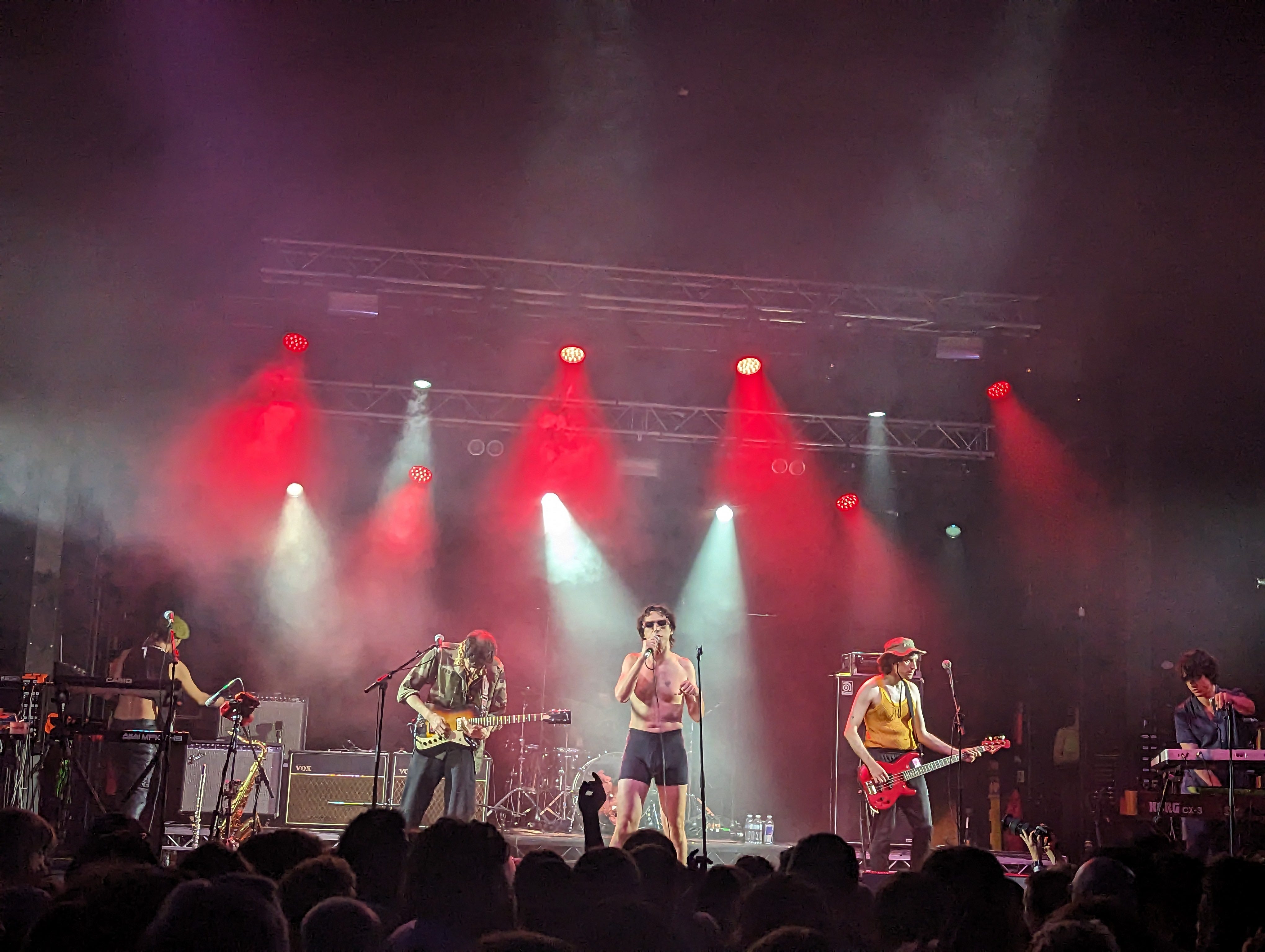
Like many a sensitive Northern boy, I moved to London at age 23 in pursuit of art and binge drinking. That was in early 2021. I moved here knowing not a single person, so I started working in pubs and going to The Windmill, the DIY venue up a Brixton side street which I had heard of for its association with bands like Black Midi and Black Country, New Road. But when I went there people didn't actually talk about those bands very much, probably because they had largely superseded it. But the Fat White Family – nearly a decade on from their first gig there, grizzled, never quite having broken through to the mainstream despite endless headlines and cult clout – were still regulars. I encountered many of the band's members individually long before I saw the full group at Wide Awake Festival in 2022, where they played a shamanic, amp-bursting barnstormer of a set which I found revelatory. What it revealed was mostly that I really liked raucous, post-punk inflected rock gigs, but as I looked into them further, I found that, beneath their puerile shock output, there seemed to be a dirtbag Corbynite ethos that I found refreshing after years of undergraduate piety1.
Once I was aware of them, the Fat White Family seemed absolutely inescapable during my adventures around South London art scenes. Every second person I met was a fan, or a hater, or knew them personally – was a bandmate or friend or relative of a member. In my first real encounter with London’s then-dormant indie literary scene, when I attended the funereal launch of British alt-lit institution Ambit’s final issue…
…the frontman turned out to have guest-edited one of its recent releases. When I went to write in South London Gallery’s café, the Wi-Fi password was – still might be – “flatwhitefamily”. I could not get away from these guys.
They had a mystique among my friends and me. They seemed larger than life, their fights and foibles prime material for smoking area gossip. My older friends were surprised – not just that they were still active (or even alive), but that they drew the interest of people in their early twenties. But they struck me as literary characters. So much had already been written about them, and each member was loud, rude and distinct. Approaching middle age, they were culturally notable but commercially struggling – and still, I heard, self-obsessed, self-destructive, and in constant conflict with the world and each other.
At some point, my attention turned to a particular member when, after a decade, he left or was fired from the band, and shortly after released a beautiful, epic solo album. I was intrigued. Here was a genuine talent, the real songwriter of the bunch, notorious for the chip on his shoulder and his addiction issues. A few months later, I saw him advertising a painting of his for sale on Instagram. I shrugged. I was bored, I was curious, I had cash lying around. I bought the painting, mostly just to see what would happen.
What happened was that I did not hear from the songwriter for a month. He didn’t respond to any of my messages. I felt like an idiot – what had I expected to happen?
But then, one day, he got in touch. He invited me to collect the painting from him at one of his gigs – this one at The Old Tressillian, one of several places dotted across London that seemed like outposts of The Windmill: pubs converted into music venues, dimlit with fairylights, with graffitied toilets and smoking areas the size of houses. It so happened that, two years ago, I had worked at this one.
Night of the gig. See me with Frank, my partner-in-crime, atop The Old Tressillian, dropping fag ends through the gaps between the hammered-on planks that made the roof a terrace. Frank was drinking from a mineswept pint, slopping in shots from a smuggled bottle of Wray & Nephew. Cars whined by beneath us, and a weighty bassline dimly thudded from inside.
Killing time before the songwriter’s set, I’d been trying to convince Frank to move into my flat. It made sense now that he’d started teaching nearby, and he already had a key and a potted toothbrush!
He set down his glass and changed the subject.
—Have you seen him yet?
He was already blinking drunk. Fiddling with a loose plank that ran along one side of the table, the nails gone at the far end and loose at his. He was pushing down the loose end, lifting the whole thing like one half of a seesaw.
—I saw Mickey rushing him to the green room right as I came in, I said. He was carrying a guitar and a big square bag, like for a painting.
—I love the idea of a heist, Frank began, watching the swinging plank. But realistically I can’t be getting into any shenanigans. I need to be on time for work tomorrow. You’re not getting me lowering from the skylight or sneaking through a vent or anything.
Right. He still hadn’t forgiven me. A few weeks ago there’d been this unexpected afters. I’d scheduled him a sick note so he could stay out late. He’d missed work, but for some reason the sick note hadn’t sent. He was now on probation. He argued it was my fault. Also, the next morning, when a neighbour’d come knocking, I’d hidden and let Frank soak the screams.
He pointed in my face.
—No shenanigans, he repeated.
—Nothing shenaniganic about it, I said. I’ve already paid him. He’s expecting me. I’m just gonna go up to him after his set.
Frank nodded, but he was already focussed on tipping up the loose plank, bringing it slightly higher each time. As it rose he leaned back on his seat. Slightly further each time. Holding on to the plank. He started to grin.
—You, he said, are a patron of the sharts.
The plank came loose. He fell entirely off his seat and stacked it onto the wooden floor. The plank clattered next to him. Some girls looked with concern, but he was laughing. He held up the plank.
—I’m keeping this.
A healthy crowd in the dim gig room. Sticky black floor, backdrop of sparkly streamers. Frank and I were waiting for the songwriter to appear. I had the plank in the New Yorker tote bag I hadn’t realised I was buying when I subscribed. People shuffled in from the bar, the smoking area.
Now here came Mickey Boome: General Manager and massive bastard – actually massive: six-foot-six with cinderblock head. Straining skinny jeans, spikes at the peak of his mullet. He’d fired me two years ago and never quite forgiven me for it. He lumbered up and nodded to Frank, then looked at me coolly.
—Alright?
—Alright, Mick, I said. Busy night?
I thought it was time we got on, but Mickey shrugged and moved away. The songwriter had emerged from the back – stalked through the crowd, frowning, sunken eyes and battered white suit, scuffed acoustic at his torso. Up onstage. He sat, and tuned.
—Mickey really hates you, Frank said.
—Roomful of children chuntering, the songwriter growled into the microphone. We all hushed. He started to strum and sing.
Majestic – mellifluous – magisterial…
Amid smoke and low light…
Simple strums… Singing synths like moonbeams…
“Writing about music is like dancing about architecture.” Just trust me, it was wonderful.
Beside me, three 20-year-olds were muttering louder than they thought they were. More of them throughout the audience. Covid kids with no manners generating a general hum and chunter. The songwriter kept playing but looked furious. His usual frown was unusually directed. Between his heavenly songs he grunted, grumbled, slagged us off:
—Bunch of middle-class students.
—Absolute cunts.
—I’m too old for this.
The fuller and more beautiful the music grew – swelling cello lending depth – the nastier his affect. I hadn’t known eyebrows could furrow so fully. Frank and I exchanged looks as I reconsidered approaching him for the painting, wondered whether he’d split the canvas over my head.
He reached his final song's long outro.
Chords repeating, building, climbing…
The cello booming around it…
A drone like the roar of a plummeting plane…
Toward some peak, some climax, some crash, some—
The songwriter leapt up, pulled the strap from his shoulders and threw his battered guitar at the floor. The room recoiled. He pointed at someone in the front row.
—Stop fucking talking!
With that he charged offstage, strode for a side door, and disappeared.
Then came Mickey through the crowd. People lurched out of his path. His gentle shoulder taps had a shove’s gravity. When he reached the front, he climbed onstage and leaned down to the mic.
—Err, he said, he’ll be back in a few minutes. I’ll just go and find him. Don’t fuckin’ – don’t go anywhere…
—For fuck’s sake, Frank hissed.
I was grinning.
—I am never getting that painting, I said.
The crowd murmured. The lights went up. I looked at Frank, who shrugged.
—Sorry fella. Drink?
But I was already turned around, starting to push through the crowd toward the bar. There was Ania, hand on a tap like a ship’s tiller, watching the swerving sea of people. She smiled grimly at the sight of us.
—He’s got problems, she said.
—He’s got my painting, I said.
—He is too old for this place. Like me. What painting?
—Elliot bought a painting from the diva drug addict, said Frank, and now he’s surprised he can’t get it off him.
—I think it’s in the green room, I said.
—Can we get a pint? said Frank.
—Can we get into the green room? said I.
Two fat glasses appeared in Ania’s hands. The tap spewed.
—He wasn’t in the green room, she said. He was in the flat.
The flat: Mickey’s gaff at the top of the pub. In exchange for her constant availability, he let Ania live in the spare room. She was 34 years old.
—Could you get it for us? said Frank.
She looked around as she poured.
—I can’t leave the bar. Ask Mickey.
—Mickey hates us, I said.
—Mickey hates you, Frank corrected me.
—He hates you by association, I said. Anyway he’s currently distracted. We can just go and get the painting ourselves. Can we have your key, Ania?
Ania clunked the pints onto the bar. She turned and prodded at the till’s touch screen. A decade old, slow to load. Finally she turned back, holding out the PDQ. I whipped out my card, then paused. Bunched with the card machine was Ania’s key to the flat. I looked at her and without moving her head she pointed with her eyes to the security camera overhead.
—He watches, she said. Don’t go anywhere but the living room. I’ll watch your drinks.
I took the PDQ and key from Ania, paid, returned just the machine. You’re a legend, I said.
Frank took his pint. I reckon you can do this on your own, he said.
I turned to give him a pained look. Frank, I said. François…
—I said I wasn’t up for any heist, he said. I have a job.
I grasped his shoulder, looked in his eyes.
—Are we not metal men?
Frank blinked. He grimaced, then picked up his pint and downed it. Then he picked up mine and downed that too. I watched lovingly his bobbing Adam’s apple. The glasses clinked down, one after the other.
—Fine, he said. Quickly. You need a job.
In a shadowy corner of the gig room was the door to the stairs. The code hadn’t changed. The stairs had been carpeted but creaked and strained the same.
Mickey was out front of the pub, on the narrow pavement that buffered it from the road’s heavy flow, shouting down his phone at the songwriter. In the stairway we could hear his muffled curses.
—It’s so dark, Frank complained.
—There’s no lights in here.
—Fuck’s sake.
His phone torch ignited on a poster of the songwriter from a decade before, pre-smack, nose unbroken, eyes clear, scowling down angelically from the shared front of his old band.
—That’s on the nose, I said. Come on.
We stumbled drunk upstairs, the plank in my bag banging often on the wall, till we came to a short hall. Left was the door to the pub’s huge kitchen, disused except by Ania. Right was Mickey’s front door. I stepped up to unlock it, then stopped. I turned to Frank and blinked in the light of his phone’s torch.
—Wait, I said. Are you sure about this?
Frank tilted back his phone, so his face was lit from below Halloween-style.
—This was your idea, he hissed. I wanted to be in bed by now. We’re breaking and entering. But I’m your friend, so…
—We’re not breaking. We’ve got a key. But what if he’s got a dog? Or a wife?
Frank blinked. Does he?
—He didn’t have a dog two years ago, I said. He did have a wife, but not anymore.
—It’s probably fine, then. Now hurry up before he comes back. In and out.
—In and out, I agreed. I opened the door, and we fell through it.
Mickey’s living room was empty and full in the way only a divorced man’s flat could be. Clutter spread like shockwaves from a central chaise extra-longue, the only furniture in the room. Nails where pictures must’ve hung. A standless TV on the floor. But one wall was plastered with Mickey’s memoirs: thirty years of gig posters. Happy Mondays, Blur, Oasis, Inspiral Carpets, The Libertines, Arctic Monkeys, amid a sea of nameless guitar bands only Mickey remembered, all constellated around his true love: his own acoustic guitar.
—Found the painting, said Frank from behind me.
I heard him unzip the canvas bag.
—Fucking ugly, said Frank. Why did you want this?
But I was looking at the guitar.
—He calls this Noel, I said.
—What?
—The guitar. Mickey calls it Noel.
I took the bag with the plank off my shoulder and tried to lean it against the chaise extra-longue, but I was drunk, and it clattered straight to the floor. Undeterred, I took the guitar down from its bracket.
—He used to serenade us while we closed the pub. He’d sit on a table and play songs he wrote when he was twenty.
—Was he good?
—He was shit. Maybe he was fine twenty-five years ago. He just sounded like…
I cradled the guitar in my arms, strummed once with my thumbnail, made some dumb long grunt. Frank grinned. I did it again, and again, and Frank laughed, so I kept doing it, until—
—What the FUCK are you doing?
There was Mickey bristling in the doorway. Frank and I stood there, frozen, silent both, for fear and for the stupidity of the question. What did we seem to be doing?
—Well?
—We came to get this, said Frank, holding up the painting meekly. Elliot—
He nodded to me in case Mickey’d forgotten who I was.
—Elliot bought it off ——— a month ago.
I nodded eagerly. Ania let us up, I said.
—And you just thought you’d nab a little something on your way, is it?
I rushed to set Noel back in its bracket.
—We’re just messing around, I said.
—We’re a bit drunk, said Frank.
—I’m calling the police, said Mickey.
He snatched Noel out of my hands by the neck, then pulled his phone out of his pocket and started dialling. Frank and I stepped forward, whinging. He slammed the door behind him and brought the phone to his ear. We went quiet.
—Hi, he said. Police.
A second.
—Yeah, I've caught two burglars in me living room, said Mickey. Two breakers-and-enterers with their hands on my property. Two cunts. The Old Tressillian. Flat above. Aye. No, it’s not there. No, it’s like that, but it exists mostly in the realm of the imagination…
He shifted the mountain of himself in front of the door, raised Noel by the neck a little, and glinted.
—Right, thanks. No, they're not going anywhere.
—C’mon, Mick, I tried.
Mickey put the phone back in his pocket.
—Ten minutes, he said. He leaned back on the door.
—You can't be serious, I said. I looked at Frank, but he was uncharacteristically silent. So I continued:
—Ania literally just sent us to get the painting—
—You always were full of shit, Elliot.
I scoffed. Is that what this is? Three years on, you’ve still got this weird grudge?
—No grudge, said Mick. I've had hundreds of shit bartenders at this place. I've fired tons of 'em. They just don't usually keep coming back.
I blinked, looked at Frank, who was still silently staring at the floor.
—Are you really just gonna—
—Shut the fuck up, he said.
Mickey raised his eyebrows at me.
For a minute we were all silent. Frank set the painting on the floor, to stand against the chaise extra-longue, beside the bagged plank. Then he leaned against the wall and slowly sank onto the floor. I sat on the chaise extra-longue. Leaned on my knees and spied the unhoovered crumbs and dust below, which triggered a rapid-onset identification with our captor that was quickly banished by a glance at his Neanderthal aspect, his cavepainted taste in music. Here was the truth: I was simply cooler than this man. Hence his rage. It was all midlife envy.
I looked at the painting. It was properly ugly. Paint slapped on in grimy layers. Barbed wire loops jabbed through the canvas. I loved it.
After a few minutes' thick silence, broken only by the scream of passing sirens, we started to hear a distant pounding and yelling from downstairs. Mickey's head jolted up as his phone started to vghhhn. He answered.
—What's going on?
Faintly came Ania's voice. Then, strongly, the songwriter's:
—Mickey I want paying, give me my money you thieving bastard or I'll burn your pub down, I'll puncture you like a balloon so you fly off all flattening and farting, I'll-
—Come up to me flat, then, said Mickey. I can't come down this minute.
More shouting. Mickey sighed and turned to open the door. He unwrapped one finger from Noel’s neck and pointed at us.
—Do not fucking move, he said.
The door slammed behind him, lock clicking, but the silence behind it was somehow louder – loomed like the middle-aged Northerner who'd left it.
Frank and I sat in that grim hush for about four seconds. Then Frank flew to his feet and out the door. I heard him thunder down the stairs. For a second I didn't hear anything. Then:
—FUCK!
He started back up the stairs. His swelling tramp. The door swung open.
—He's locked it downstairs.
I nodded slowly, looking at the floor.
There was space next to me on the chaise extra-longue, but Frank went back to his place on the floor, against the wall. He took the little bottle of Wray & Nephew from his inside pocket, swigged it empty, then started fiddling with it, tossing and rolling it like some tumbling talisman.
—I have work tomorrow, he said.
—Sorry, I said.
—I am never moving in with you. No chance.
I looked at him. Frank, I said. It was your idea to come up here.
He blinked, spat. It fucking wasn’t, he said.
—You’re the one who started going on about a heist. In and out, you said.
—You wanted your painting!
He leaned back on the wall, blinked hard, straining to conjure a clear timeline. In real time I saw him accept my account of things, watched how he struggled to reconcile it with the resentment he was feeling.
—I'm just stupider around you, he said. It's like you have this field that drains my IQ.
—As if there was ever much to drain, I said.
The bottle hit me in the chest before I properly registered his pitching it – clattered emptily across the floor – Frank stood up, dumbly lunged at me – I, dodging, fell off the chair – landed on hands and knees – turned over to watch Frank lurch toward the chaise extra-longue.
He caught himself on its back, righted, turned. With drunken grace he caught the plank where it leaned, pulled it out of the tote bag, brought it high.
—Frank, I said.
For a long second, the plank eclipsed the shadeless ceiling light. In that second I grabbed the painting, yanked it in front of my face, held it there. Then the plank tore through the mottled back of the canvas.
I saw Frank’s face through the torn sheet, the twisted wire. He threw the plank down. His eyes bulged slightly. He dropped backward onto the chaise-extra-longue. Rubbed his face with both hands. I flipped the painting about. The hole flapped open. The left frame had fractured. The painting was a wreck – totalled – aura abolished. I sat up. Chuckled. Put my hand on his knee. A siren shrieked somewhere.
—François, I said. Frank...
He looked down at me, his rage filtering to confusion as I guffawed into his lap. That's how Mickey found us when he came back.
At some point this post becomes a work of fiction, and any resemblance to real persons becomes purely coincidental.
Never mind the incidental right-wing flirtations.